
Why AI will widen the gap between international firms
There are two broad operating models among international professional services firms.
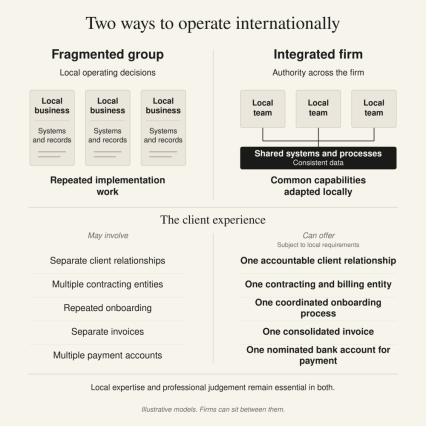
The first brings together local or regional businesses that continue to operate largely independently. They may share a name, report consolidated financial results and even have common ownership. Decisions about systems, processes and commercial priorities are still made mainly within each business.
The second is structured to operate as one firm across countries. It combines common ownership with management that has authority across the business. Teams use shared systems and common processes, and incentives are aligned with the performance of the firm as a whole.
Firms sit at different points between these models. I expect AI to widen the gap between those that have built the foundations to operate as one and those that remain fragmented. Give both access to the same AI tools and they will start from very different positions.
The integrated firm can redesign how an international engagement is delivered and apply an improvement across the teams involved. The fragmented firm has more arrangements to negotiate and more systems to connect before it can achieve the same result. That difference affects the cost of implementation and how much of the benefit reaches the client or the firm’s financial results.
Building the firm to operate together
Common ownership allows shareholders to fund shared capabilities and appoint management with authority across the group. That authority has to extend to decisions about where work is performed, how processes change and which systems the firm uses.
Clients should experience that integration in their dealings with the firm. Where local requirements permit, an international engagement can be managed through one accountable client relationship and one contracting and billing entity. That means one coordinated onboarding process, one consolidated invoice and one nominated bank account for payment.
The firm coordinates the local teams and allocates charges internally. For the client, this reduces repeated onboarding, separate supplier records and payment administration. There is also a clear point of accountability when something needs resolving.
In an IP firm, a shared technology environment would include one IP management system (IPMS) for rights and matter workflows, one document management system (DMS), a common finance platform (ERP), a client relationship management system (CRM) and a human resources information system (HRIS). Connecting them allows an approved client instruction to move into delivery and billing without teams recreating the engagement at each stage.
The systems also need to describe the work consistently. Client, matter, and progress identifiers must align. Teams need agreed definitions of what has been completed, what requires approval and who is responsible for the next step. Separate configurations and inconsistent records can preserve fragmentation even when every office uses the same software.
Local expertise remains essential. Country requirements can be built into the relevant workflow, with practitioners responsible for professional decisions. Separate legal entities, confidentiality restrictions and permissions can be accommodated within the shared operating model. Local differences should be understood and designed for.
Following an international instruction
Consider a client asking its IP firm to protect a trademark in 20 countries. The firm must confirm the scope, collect the required information, arrange the filings and deal with subsequent developments. The client expects timely and reliable updates, consolidated billing and a clear route for payment.
In an integrated process, the instruction would establish a common engagement record linked to the relevant local matters. The documents and agreed charges would be available to the teams entitled to use them. AI could extract information from the instruction into draft records and flag missing documents for review. As work progressed, it could prepare updates from recorded matter activity. Practitioners would review the work and take responsibility for decisions requiring their judgement.
Management could follow the engagement through delivery, billing and collection. A delay would have an identifiable owner. The client partner would have less information to assemble manually before explaining what was happening across the portfolio.
In a fragmented group, the same instruction may be entered into several local systems. Teams may need to reconcile different matter numbers, document versions and status descriptions. Each office could use AI to work faster while the client partner continued chasing updates and combining the results. Some of the most time-consuming work sits between those offices.
The economics of integration
A common process gives an AI investment a larger base of work over which to earn a return. A capability developed and tested for that process can be extended to other teams, with configuration and validation for local requirements. Each new AI workflow can use established records, process definitions and permissions. Improvements can be incorporated into the shared capability. Support and maintenance are easier to organise when the firm is managing fewer variations.
A fragmented group may have to repeat parts of that work for different systems and procedures. It may also need separate agreement from each business about adoption and funding. These costs continue after the first implementation, whenever the technology, controls or underlying process changes.
There is a financial decision behind many of these changes. Suppose administrative work can be completed more efficiently by a shared team. An office may lose the revenue attributed to that activity while retaining some of its overhead. A manager assessed on that office’s profit has a reason to resist. Common ownership gives the group a basis for resolving the allocation of revenue and cost, but management still has to make the decision and align remuneration with it.
The return also depends on what happens to the capacity released. Time saved becomes financially useful when it allows the firm to absorb profitable work, reduce avoidable expenditure or improve service enough to retain and win clients. The calculation has to include the cost of professional review, corrections and maintaining the technology.
Connected operational and financial records make that assessment easier. Management can examine the cost of a completed engagement and how quickly the work turns into cash. It can see whether an apparent saving in one team has created additional work elsewhere. That is a stronger basis for deciding which AI capabilities deserve further investment.
In an October 2026 briefing, MIT researchers Peter Weill and Stephanie Woerner warned that deploying AI agents before deciding how processes and data should be integrated can embed fragmented ways of working in automation. International firms have good reason to address those decisions before extending AI across their businesses. MIT CISR
Making the structure work
At CWB, this is the purpose of our Renaissance programme and Jarvis AI operating model. Renaissance develops the connected systems, common processes and reliable data needed to support our international business. Jarvis defines how AI can work within that environment, including what it may access, which actions it may take and where human review is required. The work continues as we introduce capabilities across the firm. CWB
Getting there requires substantial management effort. Records have to be cleaned, responsibilities clarified and people supported through changes to familiar ways of working. Systems may need to be replaced while the firm continues serving clients. Those costs belong in the investment case.
For an international group that remains fragmented, the immediate task is to establish which parts of the business will operate together and give management the authority to make that happen. A shared brand or consolidated financial statements reveal little about how far that work has progressed.
The useful test is to follow an international instruction through the firm. Where is information recreated? Who can change the process across countries? Can a successful improvement be extended to the other offices? How will the firm capture the financial benefit?
Firms that have established those foundations have already completed a demanding part of the work required to implement AI. They can devote more attention to improving delivery and extend successful changes across the business. As those improvements accumulate, I expect their advantage over fragmented international competitors to become increasingly difficult to match.
For more information, please contact:
